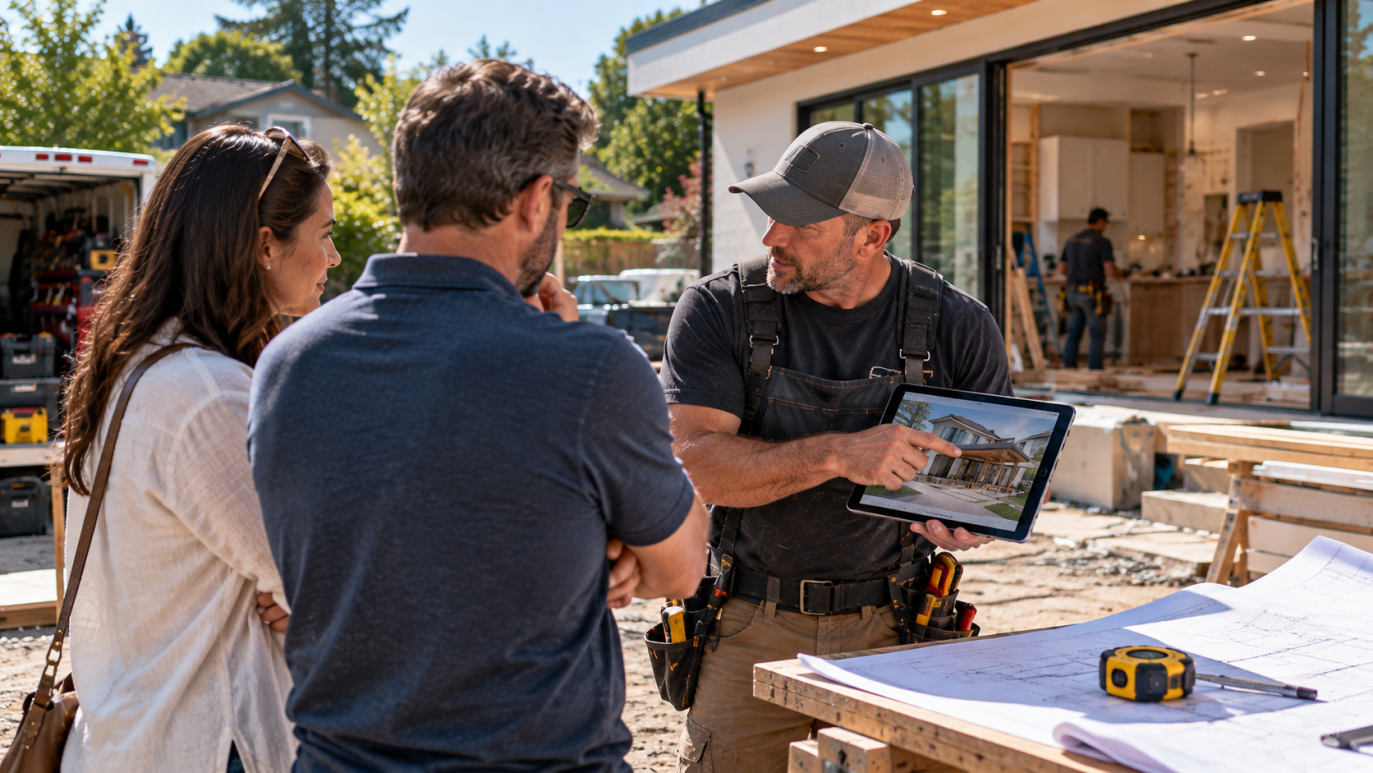
General contractor marketing usually gets judged by how many calls it produces, but for most building and remodeling projects the real decision happens earlier, on your website, before the homeowner ever picks up the phone. A family planning an addition or a whole-house renovation is about to trust you with their home and a large share of their savings, so they read your site looking for reasons to believe you, or reasons to move on.
Homeowners do not need a design degree to spot a weak contractor site. They notice missing credentials, stock photos and vague promises within minutes, and every gap is a quiet reason a strong prospect calls someone else.
Why general contractor marketing lives or dies on your website
Referrals, yard signs, ads and search results all point to the same place. Even a warm referral from a neighbor usually gets checked online before anyone calls, because a large project feels too risky to hand over on 1 recommendation.
Reviews start that process, and your site finishes it. In BrightLocal’s Local Consumer Review Survey 2026, 54% of consumers said they go on to check the business’s website after reading positive reviews, so a strong rating sends prospects straight to a site that either confirms their good impression or undoes it.
That makes your website the handoff point for every other channel. If it cannot answer the basic trust questions, the money you spend driving traffic leaks out before the first call, which is why a serious general contractor marketing plan fixes the website before it buys more attention.
Run this audit the way a homeowner would. Search for your company name on your phone, open your site from the results and give yourself 2 minutes to find what you build, where you work, proof of recent projects and how to get in touch. Anything you cannot find in that time, a prospect will not find either.
Checklist part 1: does the first screen answer who, what and where?
The top of your homepage has one job: tell the right homeowner they are in the right place. Run through these 3 questions on both a laptop and a phone.
Can a visitor tell what you build at a glance?
Your headline should say what kind of work you do and for whom, such as whole-home renovations and additions for older homes. A slogan about quality and craftsmanship does not count, because every contractor in your market can claim it.
Are your service towns visible without scrolling?
Homeowners want to know right away whether you work in their town. Name your core service area near the top of the homepage and repeat it on every service page, so nobody has to email you to find out.
Is there one clear next step?
Pick a primary action, such as scheduling a consultation, and keep it visible on every page. On phones, a tap-to-call button in the header saves a prospect from hunting for your number.
Curious how your website scores against this checklist?
Checklist part 2: is your proof real, specific and recent?
Proof is where most contractor sites fall short. A gallery of unlabeled photos says you own a camera, while a documented project says you can be trusted with a budget and a timeline.
Do your project pages tell a story?
For your best 6 to 10 projects, show before and after photos, the town, the scope, the main challenge and how you solved it. Real job site photos beat stock images every time, because homeowners can spot a stock kitchen instantly.
Do you show work in progress, not just finished rooms?
Finished photos show taste, but job site photos show how you work. Clean, protected floors, organized material staging and a tidy dumpster area tell a homeowner what living through your project will actually feel like, which is often their biggest worry.
Are reviews on the site, attributed and current?
Feature reviews with first names, towns and the type of project. The same BrightLocal survey found that 74% of consumers look for reviews written in the last 3 months, so a testimonials page that has not changed in years quietly works against you.
Do your reviews match the projects you want more of?
If you want more additions, feature reviews from addition clients near the top. A steady system for requesting and responding to reviews is the heart of reputation management, and it keeps this part of your site fresh without extra effort.
Checklist part 3: can homeowners verify your credentials?
Credentials should appear as readable text, not only inside a logo image. List your state license or registration number, confirm that you carry liability insurance and workers’ compensation, and name any manufacturer certifications or trade association memberships you actually hold.
Make verification easy. If your state lets homeowners look up contractor licenses or registrations online, say so and tell them where, because a contractor who invites scrutiny looks like one with nothing to hide.
Keep these details consistent everywhere they appear. The license number on your site should match the one on your proposals, your trucks and your Google Business Profile, because a homeowner who notices a mismatch starts wondering what else is out of date.
Local roots count as proof too. Mention how long you have worked in your core towns, the neighborhoods or home styles you know best and any community involvement, so homeowners see a neighbor rather than a stranger with a truck.
Warranties belong here too. Spell out what your workmanship warranty covers and for how long, in plain language, so homeowners do not have to wait for a proposal to learn how you stand behind the work.
Checklist part 4: does your site explain the process and the investment?
Uncertainty is one of the biggest reasons homeowners delay a project. A page that walks through your process, from first consultation to design, permits, construction and final walkthrough, shows that you run an organized business.
Do you share typical project ranges?
You do not need a price list, but a typical starting range for your main project types filters out mismatched leads and builds credibility with the right ones. Homeowners who see a range and still call are far more likely to be a fit.
Do you show the people behind the company?
Photos and short bios of the owner, project managers and lead carpenters turn a logo into a team. For a job that may last months inside someone’s home, knowing who will show up every morning matters a great deal.
Do you explain what happens after the first call?
Tell visitors exactly what to expect once they reach out: who calls them back, how soon, what the first meeting covers and when they will see a proposal. Removing that mystery makes the first call feel low risk, and low risk is what gets a cautious homeowner to pick up the phone.
Checklist part 5: general contractor marketing needs a site that works on every device
Many homeowners will look at your site first on a phone, often between other tasks. Check that pages load quickly, photos are sized properly, text is readable without zooming and forms ask only for what you truly need.
Look closely at your forms as well. A short set of questions about project type, town and timeline helps your team prepare for the first conversation, while a long form full of required fields sends impatient prospects back to the search results.
Test your own contact form and phone number every month. A broken form or an outdated number can silently erase the results of every other part of your general contractor marketing, and nobody will email to tell you it failed.
Finally, measure how fast your team responds, because the best website still loses to a competitor who calls back within the hour. When an audit uncovers bigger structural gaps, a rebuild through website design and development is often faster than patching an old site page by page.
Frequently asked questions
What should a general contractor website include?
At minimum: a clear headline describing your work, your service towns, detailed project pages with real photos, recent attributed reviews, license and insurance details as readable text, a simple explanation of your process, team photos and an easy way to call or request a consultation from any page, including on phones.
Should contractors put prices on their website?
A full price list is rarely practical, since every project differs. Sharing typical starting ranges for your main project types usually helps, because it filters out prospects with mismatched budgets and signals transparency. Pair each range with the factors that move the price, such as scope, materials and site conditions.
Do general contractors need a website if they get referrals?
Yes. Referred homeowners almost always look you up before calling, and your website is where they confirm what the referral told them. A thin or outdated site can undo a strong recommendation, while a credible one turns referrals into consultations faster and helps you win jobs against contractors they found elsewhere.
How do I market myself as a general contractor?
Start with a website that earns trust, then build the channels that send people to it: a complete Google Business Profile, a steady flow of reviews, search visibility for your core services and, where it fits, targeted ads. Focus on the project types and towns you want most instead of chasing every lead.
Your website is the first meeting most homeowners have with your company, and it happens without you in the room. Strong general contractor marketing makes sure that meeting goes well: clear services, real proof, visible credentials and an easy next step. Noble House Media builds every strategy from scratch around the projects you want more of, because the goal is sales, not promises. See the kind of work our team delivers in our portfolio.
Related posts
Popular Articles



Landscaping Marketing: Get More Leads & Referrals
October 02, 2026